
Interrail, IS it really worth it?

For those who don't know what Interrail is, it is a way of travelling around Europe by train, often popular among students after finishing high school. You travel from one city to another, usually with your friends, discovering different countries, cultures and ways of life along the way. We did our Interrail in 2023. For 17 days, we travelled from Germany to Romania and then through Italy, visiting different cities and experiencing completely different cultures. But after all the planning, trains, reservations, walking and exhaustion, one question remains: Is it really worth it?
How do you plan an Interrail?
The starting point is usually the Interrail Pass. Instead of buying a separate train ticket every time you travel, the Pass allows you to travel across participating European railway networks during a certain number of travel days. It sounds simple, but there is something important to keep in mind: the Pass does not always mean you can simply get on any train.

On some routes, especially high-speed or international trains, a seat reservation is required. During our trip, our tickets and reservations were checked several times. You will find plenty of people who managed to travel without any problems despite not having the correct reservation. But there is another side to the story: you can be checked, and you can run into problems if you have not followed the rules. Before getting on a train, make sure you know whether a reservation is required.
Another important thing to consider is that the Interrail Pass is not necessarily the only way to get a Pass. Depending on the country and the year, governments may offer discounted Interrail travel programmes. In Spain, for example, discounted youth travel passes have been offered, making train travel considerably cheaper than purchasing a standard Interrail Pass. Some people will also tell you that buying each train ticket individually is cheaper and sometimes, it can be. But for us, one of the biggest advantages of having a Pass was flexibility. If your plans change, having a Pass can make it easier to adapt your journey instead of having to buy a completely new ticket every time.
Our journey
3 friends -17 days - 8 cities - 6 countries
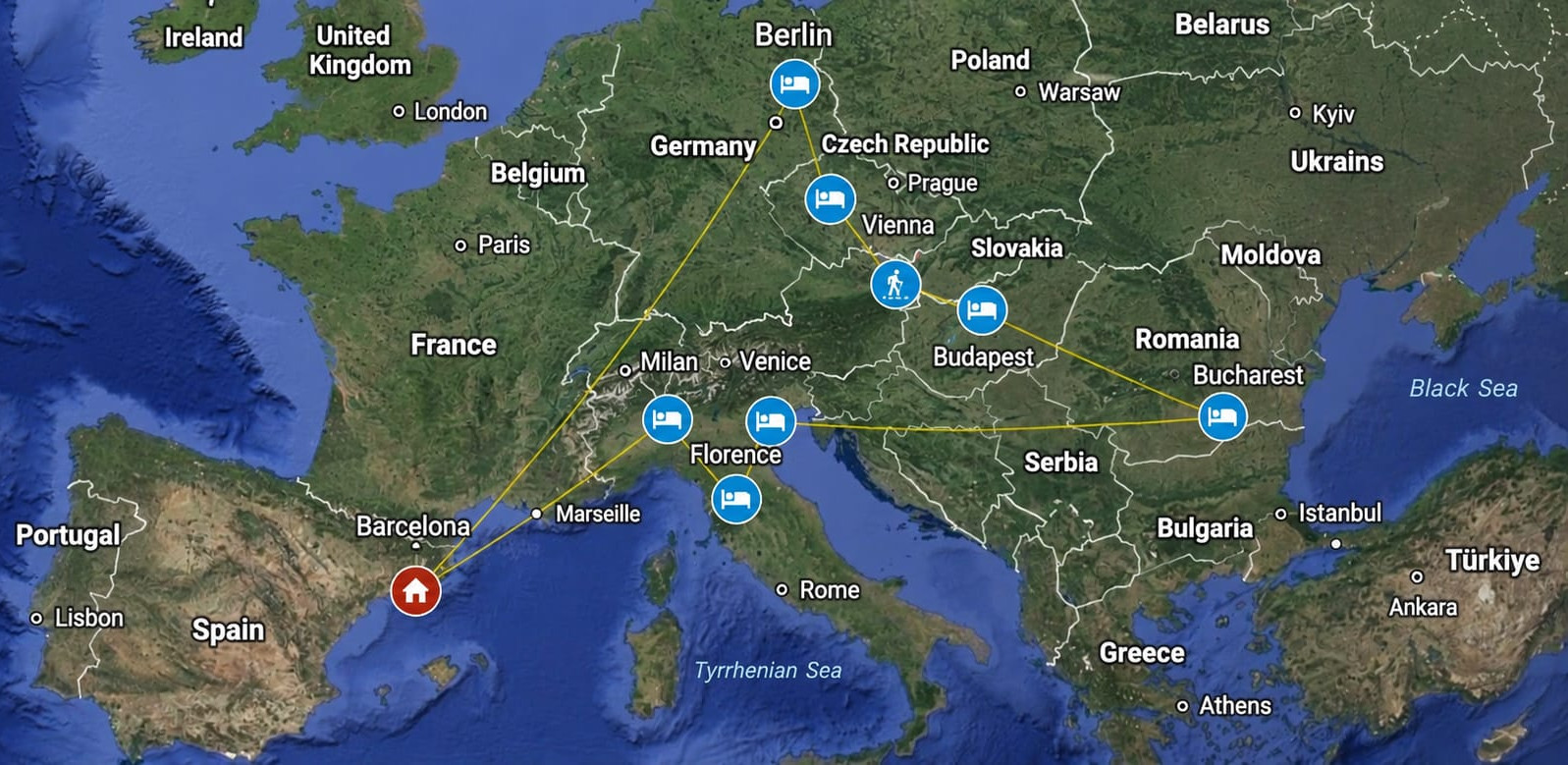
Our route took us through Germany, Czech Republic, Austria, Hungary, Romania and Italy, with eight major stops along the way. Looking back, we probably tried to do too much. Seventeen days might sound like a long time, but when you are trying to visit eight different cities, it disappears quickly. In some places, we only had enough time to spend the day there before moving on to the next destination. That taught us one of the most important lessons of our trip: less quantity, more quality. It is better to properly experience five cities than to see the surface of eight.
Travelling from one place to another every few days can be exciting, but it is also tiring. At some point, you stop appreciating what you are seeing because you are already thinking about the next train, the next hostel or the next destination. An Interrail is not a race to collect cities. Give yourself time to experience them.
The real cost
We don't have an exact final figure for our trip, but taking everything into account, we estimate that the whole experience cost us somewhere between €900 and €1200 per person. That included the main expenses of the trip, such as transportation, accommodation, food and other costs along the way. The exact amount, of course, depends heavily on how you travel, where you stay, when you go and how many trains you take.
So, is Interrail worth it?
For us, yes.
But not simply because it allows you to visit a lot of places. Interrail is much more than tourism. It is about discovering different places in a relatively short period of time, constantly adapting to new surroundings and being challenged every day. For many people, it can also feel like the beginning of a new stage in life. You are travelling with your friends, making decisions together, dealing with unexpected situations and learning how to live together. You learn about Europe, but you also learn about the people you are travelling with. At the same time, you have to understand what you are signing up for. An Interrail trip demands energy, flexibility and enthusiasm. You are moving almost every day, you walk for hours, carry your bags, catch trains, change accommodation and constantly adapt to a new environment. Eventually, the exhaustion starts to show. That is why who you travel with matters. You need people who are willing to adapt, compromise and accept that things will not always go according to the plan. You need to be able to change your plans without letting a small problem ruin the whole trip. You will take little pieces of each place: a street, a conversation, a meal, a train journey, a building, a smell, a moment and when you put all those pieces together, you start to understand something bigger. You get a glimpse of what Europe is. Maybe that is what makes Interrail worth it. Not the number of cities you can tick off a map. Not even the money you save. But the experience of moving through different cultures, sharing 17 days with your friends, being exhausted, getting lost, adapting, laughing, arguing, discovering and eventually coming home with a much bigger picture of the world than the one you left with. However, it is important to remember the importance of respecting every country we visit. Each place has its own traditions and culture. People and cultures are not attractions, they are part of the reality we travel to discover.
Interrail isn't just about where you go. It's about everything that happens between one destination and the next one.
Life won't wait: Vive Omnia.
Comments